Before You Buy Another Course, Go Sit With Someone Who Quilts
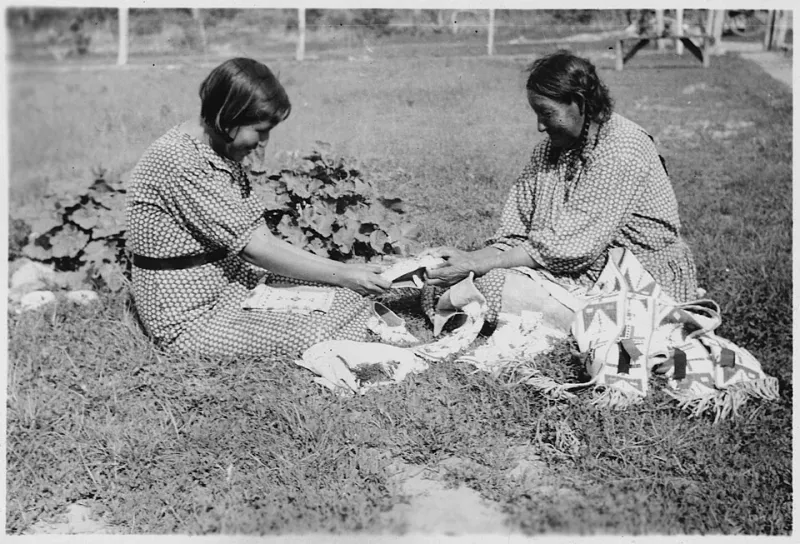
Photo: Unknown authorUnknown author or not provided, Public domain, via Wikimedia Commons
There's a particular kind of irony in watching someone watch a 40-minute video tutorial on fabric dyeing while their grandmother — who has dyed fabric in a sink in Ohio for fifty years — sits in the next room.
We've all done some version of it. We treat learning as something that has to be downloaded, streamed, and completed at 1.5x speed. Meanwhile, the people who actually mastered their crafts did it with a folding table, a church basement, and a lot of patience.
Here's the contrarian pitch: the least tech-savvy person you know might be the best craft instructor you have access to.
The Curriculum No One Wrote Down
Think about what older hobbyists actually know. A quilter doesn't just sew — she understands fabric grain, thread tension, why cotton behaves differently in a Georgia summer than a Minnesota winter. A whittler knows wood the way a chef knows produce: which grain will split, which knife angle forgives a mistake, how the smell of cedar tells you something before you ever touch it.
That's material knowledge, and it's nearly impossible to compress into a course module. It lives in the hands. It gets transmitted through watching, failing, and being gently told "nope, try again" by someone who's made that mistake ten thousand times.
Online platforms are phenomenal at teaching you what to do. Elders teach you how to be while doing it. That's the difference between following a recipe and cooking.
What You Can't Get From a Subscription
Modern learning platforms optimize for speed and scale. That's their strength and their blind spot. What they can't offer:
Real-time correction. A YouTube comment section can't stop your hand mid-cut. A person across the table can — and will, before you waste an hour of work.
Improvisation. When the store is out of the exact batting a tutorial calls for, the video doesn't help. Grandma has already solved that problem three ways, using what was in the closet.
Patience as a practice, not a platitude. A woman who spent six months on a single wedding quilt carries a relationship with time that no progress bar can simulate. Sit with that long enough and it changes how you approach your own work.
Permission to be slow. There's no streak counter in a sewing room. There's just the work, and the person, and the afternoon.
Finding Your Living Library
Okay — but what if your relatives don't quilt, or you don't have that grandparent figure in your life? Good news: America is quietly full of them.
Start with the senior center, not the search bar. Call your local senior center, community center, or VFW hall. Ask if they have craft groups, woodshop hours, or a model railroad club. Most will say yes. Most will be delighted you asked.
Try the church basement circuit. Quilting bees, knitting circles, and canning workshops still happen weekly across the country, and they're almost always looking for younger hands. Showing up curious is the entire price of admission.
Ask the hardware store employee. The person at the counter of a small-town hardware or fabric store knows exactly who in town whittles, restores furniture, or repairs clocks. That's a directory no app has replicated.
Offer something in return. You have something they want, too: help with the phone, the printer, the online order of replacement parts. Trade tech support for workshop time. It's a fair deal and a genuine friendship starter.
How to Actually Learn Once You're There
Apprenticing with an elder isn't like enrolling in a course, so don't treat it like one.
- Watch longer than feels comfortable. Resist the urge to grab the tools. Ten minutes of observation teaches more than ten minutes of fumbling.
- Ask about mistakes, not techniques. "What's the worst thing you ever ruined?" unlocks better stories and better lessons than "How do I do this?"
- Accept the slow pace. You might spend a whole session just sanding. That's not wasted time — that's the curriculum.
- Take notes on principles, not steps. "Measure twice" transfers. The specific seam allowance of her particular machine doesn't.
- Come back. One visit is a novelty. Four visits is an education.
The Part Where You Win Either Way
Maybe the craft itself won't stick. Maybe you'll never can another jar of tomatoes in your life. That's fine — because what you'll actually absorb is a mindset the modern creative world badly needs: resourcefulness over consumption, patience over optimization, material honesty over shortcuts.
Every subscription platform wants you as a customer. The quilter in the church basement just wants you to hold the other end of the fabric and pay attention. One of those is a better teacher.
So before you add another course to your cart, make a phone call instead. The most analog learning experience available to you might also be the most advanced.